Millions of Texans are Waiting.
We have the Solution.
Prescribing Psychologists are safe, rigorously trained, and already improving mental health outcomes in eight states, the U.S. military, and federal health systems.
It's time for Texas to join them.
-
“We have all these doctoral providers who are experts in evaluation and diagnosis, and who are willing to get the extra training to prescribe... why aren't we using them?”
— Dr. Blaise Aguirre, M.D.
Harvard University
-
“[With a] shortage of 45,000 psychiatrists... PCPs are dealing with longer waitlists than psychiatrists... Let's give medically-trained psychologists prescriptive authority.”
— Dr. Daniel Carlat, M.D.
Tufts University
-
"Who do you want to have a prescription pad...? Somebody who understands the condition, has diagnosed the condition, and works with those patients? Or somebody whose training has not given them that level of depth and understanding?"
— Dr. Donald Fineberg, M.D.
Private Practice
3.3M
Texans with no access to a psychiatrist
248/254
Texas counties with mental health prescriber shortages
24,698
Texan lives lost to suicide since 2017
30+
Years of psychologists safely prescribing in the U.S. military and other states
What is Prescriptive Authority for Psychologists?
Prescriptive authority — known as RxP — allows licensed psychologists who complete an additional master's degree in clinical psychopharmacology, pass a national board exam, and finish two years of supervised training to prescribe psychotropic medications.
This isn't a shortcut; it's 12 to 14 years of post-baccalaureate training. Prescribing psychologists are among the most extensively trained mental health prescribers in the country, with more hours in pharmacology, psychological assessment, and psychotherapy than any other prescribing profession (Muse & McGrath, 2010).
Eight states, Guam, the Indian Health Service, the U.S. Public Health Service, and all branches of the U.S. military already authorize prescribing psychologists. The evidence from these jurisdictions is clear: prescribing psychologists are safe, effective, and they save lives.
What the Research Shows
24% fewer adverse drug events
Patients of prescribing psychologists experienced significantly fewer adverse drug events and 20% less polypharmacy compared to those treated by psychiatrists. Based on over 307,000 patient records.
5–7% reduction in suicide rates
Two independent studies — one by an economist, one by an epidemiologist — found that states with prescribing psychologists saw measurable declines in suicide rates within years of implementation.
38% of practices in rural areas
Prescribing psychologists in New Mexico are going where psychiatrists aren't. 97% accept Medicaid. They see patients with moderate-to-severe symptoms — the patients who need help the most.
How You Can Support RxP in Texas
Legislators or Staffers
Access bill summaries, fact sheets, workforce data, and district-level cost savings.
Physicians
See how prescribing psychologists compare in training, collaborate in practice, and what physicians who've worked alongside them have to say.
I'm a psychologist, patient, or supporter
Find out what RxP means for your community, read patient stories, and take action to bring RxP to Texas.
A Proven Model, Growing Nationwide
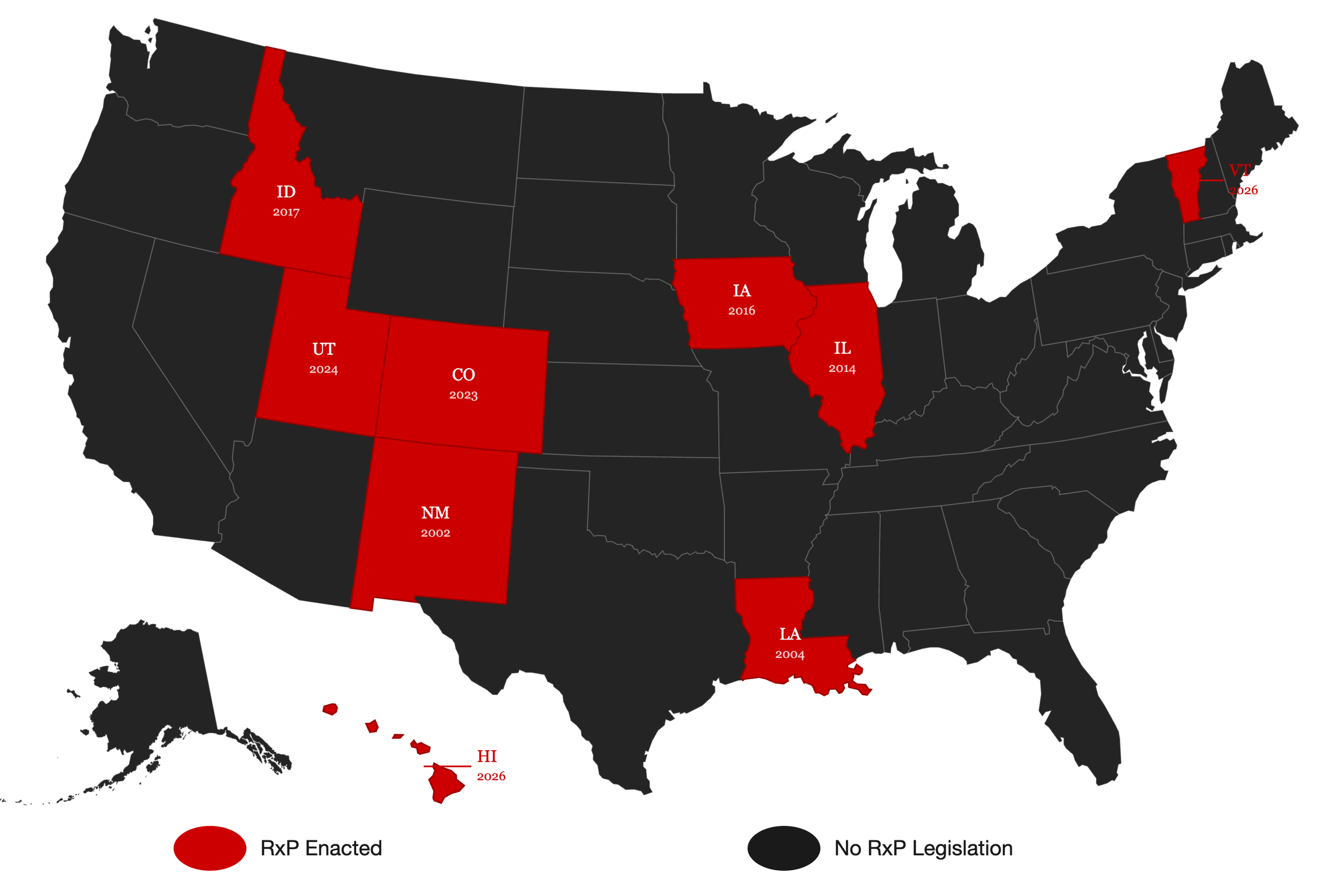
Prescribing psychologists are already authorized in New Mexico (2002), Louisiana (2004), Illinois (2014), Iowa (2016), Idaho (2017), Colorado (2023), Utah (2024), and Vermont (2026) — plus all branches of the U.S. military, the Indian Health Service, and the U.S. Public Health Service. Hawaii enacted a three-year pilot program in 2026 that allows psychologists to prescribe under physician supervision at federally qualified health centers on Kauai and Hawaii Island.
Every state bordering Texas either has or is actively pursuing prescriptive authority for psychologists. Approximately 300 prescribing psychologists practice across the country, and no state that has passed RxP has ever repealed it.
The question is not whether this model works. The question is, how long will Texas wait?
The Cost of Waiting