House Bill 5537, filed by Representative Mary González, and its Senate companion SB 2999, filed by Senator José Menéndez, would let psychologists who complete advanced psychopharmacology training prescribe psychotropic medication under a graduated, supervised license, leading to independent practice. It is the same model now operating in nine states and across the U.S. military.
What These Bills Do and What They Cost
HB 5537 creates a two-tier certificate administered by the existing Texas Behavioral Health Executive Council. A psychologist first earns a conditional certificate, which requires a postdoctoral master's degree in clinical psychopharmacology, a national examination, and supervised clinical practica. Full prescriptive authority comes only after at least two additional years of prescribing under a supervising physician or prescribing psychologist and an independent peer review of that work. Authority is limited to psychotropic medication; prescribing psychologists must notify each patient’s primary care practitioner, and the bill brings the Behavioral Health Executive Council into the state’s Prescription Monitoring Program. Through August 2028, the advisory committee that recommends rules for the program includes a psychiatrist and a pediatrician or primary care physician alongside three psychologists and a public member.
The measure carries no new appropriation and creates no new agency. The Legislative Budget Board estimated a net cost to General Revenue of $110,559 over the 2026–27 biennium for one staff position and a licensing database upgrade at the Behavioral Health Executive Council. Certification fees produce net revenue to the state of $54,441 in fiscal year 2029 and $103,441 in fiscal year 2030.
The Safety Record
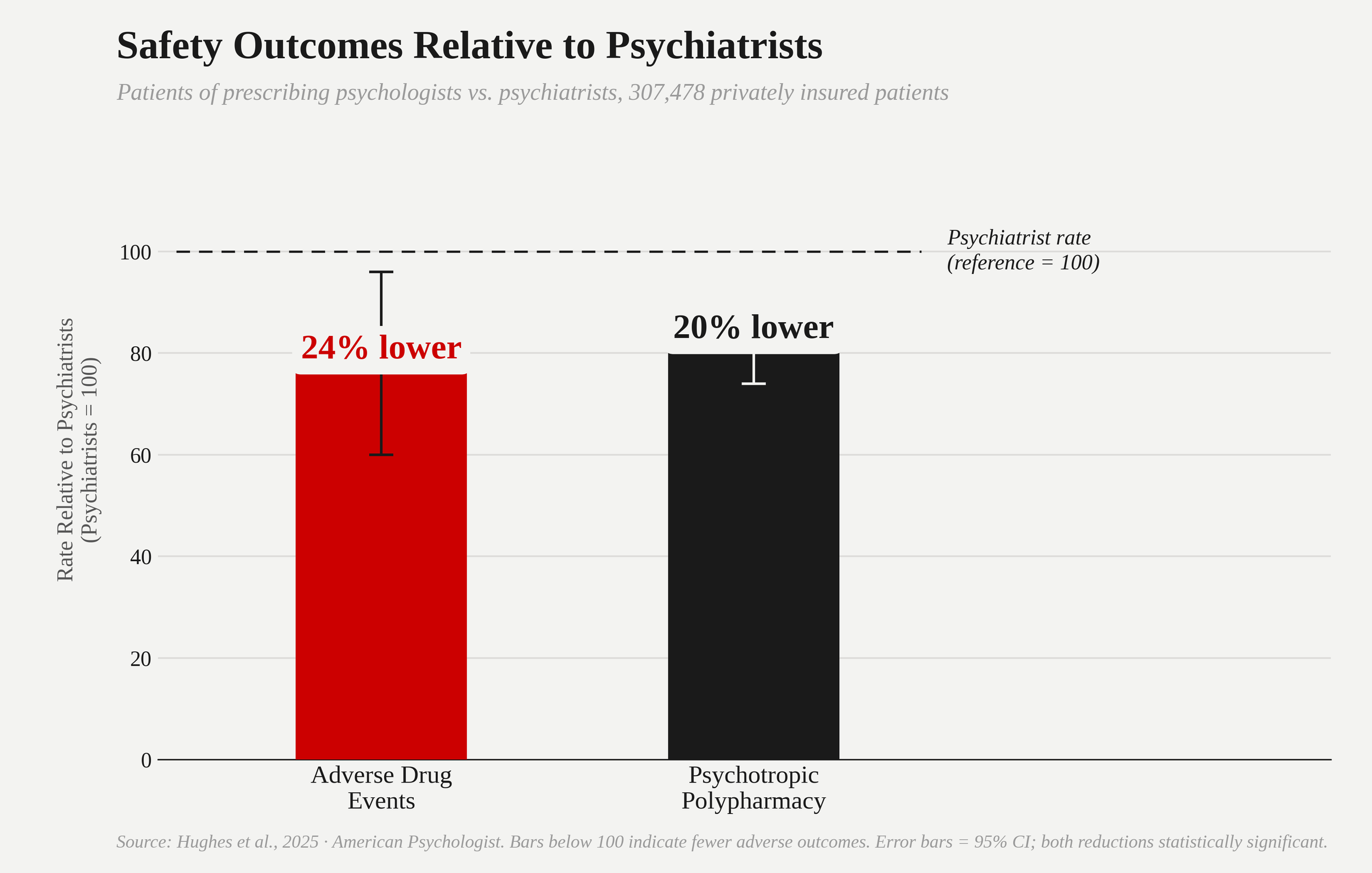
A 2025 study in American Psychologist examined 307,478 privately insured patients and found that those treated by prescribing psychologists had a 24% lower rate of adverse drug events and a 20% lower rate of psychotropic polypharmacy than patients of psychiatrists, with similar rates of psychiatric emergency department use and medication nonadherence.
A separate study found that prescribing psychologists adjusted downward or discontinued a medication for 57.8% of their patients. Prescribing psychologists can deprescribe as well.
Psychologists have prescribed safely in the Department of Defense and other federal systems for more than three decades, a history detailed on our Training page.
What Other States Found
Nine states have enacted prescriptive authority for psychologists — New Mexico (2002), Louisiana (2004), Illinois (2014), Iowa (2016), Idaho (2017), Colorado (2023), Utah (2024), Vermont (2026), and Hawaii (2026) — and none has repealed it. The longest-running programs now have more than two decades of operating history. A peer-reviewed economic analysis of these laws found that prescriptive authority increased the supply of mental health practices without reducing the number of psychiatric practices, meaning prescribing psychologists expand access rather than displace physicians. And these clinicians serve the patients legislators most worry about reaching: in New Mexico, where the law has operated longest, 97% of prescribing psychologists accept Medicaid.
Opposition Claims & Next Steps
A 2026 analysis published in Regulation, the policy journal of the Cato Institute, concluded that arguments against RxP are "strikingly devoid of empirical evidence," relying on anecdote and conjecture rather than data from the nine states where the model operates. Texas RxP responds to specific claims on the Myths vs. Facts page.
We encourage you to read the bill in full. Request testimony, data, or a briefing through the Texas Psychological Association.