Texas has a mental health crisis
Millions of Texans cannot access the psychiatric care they need
The shortage is already here, and it's getting worse
According to Mental Health America's 2025 report
Texas ranks 50th out of all 50 states and Washington, D.C.
For access to mental health care
248 of 254 counties
According to HRSA's Health Workforce Shortage Area data, 248 of 254 Texas counties have mental health professional shortage area designations. 246 have full designations, and two have partial designations. Only six counties in all of Texas are not designated as having a mental health prescriber shortage.
Of those counties, 162 do not have a single general psychiatrist. For the 3.3 million Texans living in these areas, the nearest psychiatric prescriber may be hours away.
This is consistent with the national picture. An estimated 96% of all U.S. counties lack access to adequate psychopharmacological services. 51% have no psychiatrist, and 67% have no psychiatric nurse practitioner.
The psychiatric workforce is shrinking
The U.S. could face a shortage of as many as 21,000 psychiatrists by 2030, according to projections from the Health Resources and Services Administration. The workforce that remains is aging rapidly — more than 60% of active psychiatrists were 55 or older in 2021, one of the highest proportions among all physician specialties.
The pipeline is not keeping pace. Federal caps on residency funding have constrained training capacity since 1997, and the first modest expansion — 200 slots per year across all specialties — did not come until 2020.
Meanwhile, physicians are leaving clinical practice at accelerating rates. A 2025 nationwide longitudinal study in Annals of Internal Medicine found that overall physician attrition rose from 3.5% to 4.9% between 2013 and 2019. Psychiatry experienced one of the steepest increases of any specialty, rising from 7.4% to 10.1%.
The result: wait times for a new psychiatric appointment now average more than two months, with fewer than one in five psychiatrists accepting new patients.
Most psychiatric medications are prescribed by providers with the least mental health training
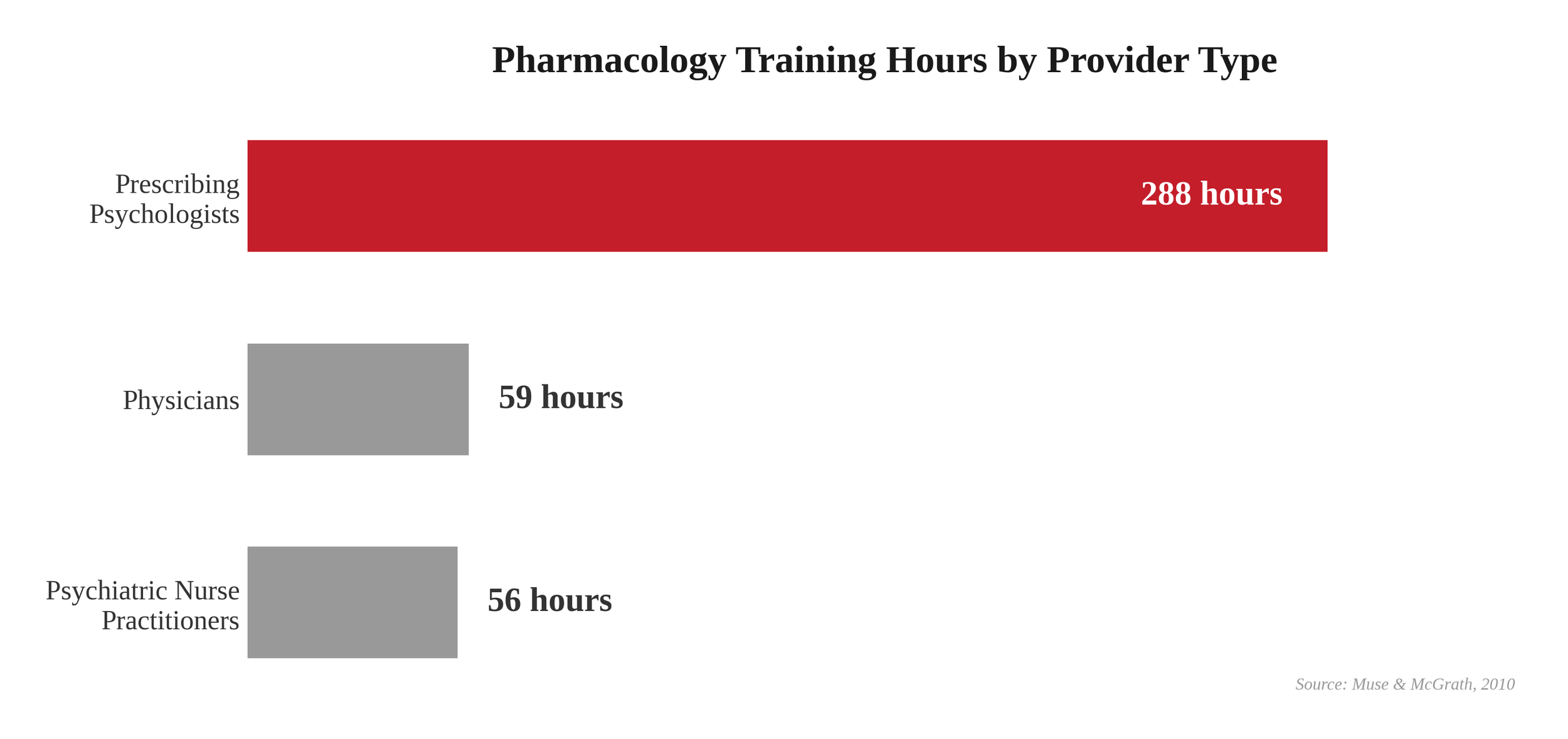
More than 60% of all psychotropic medications in the United States are prescribed by primary care physicians — providers whose medical school training included approximately 59 contact hours of pharmacology and minimal formal training in psychological assessment.
A 2026 Medscape survey found that one third of PCPs report more than 20% of their patients need mental or behavioral health treatment, and 84% say they must play an essential role in this care because specialist providers are not available.
One in six American adults takes at least one psychiatric medication. The providers shouldering most of that demand have the least specialized training to manage it. By comparison, prescribing psychologists complete 288 contact hours of dedicated pharmacology didactics, versus 59 for physicians and 56 for psychiatric nurse practitioners.
Even when there's a psychiatrist nearby, insurance creates a second barrier
Psychiatrists accept insurance at far lower rates than other physicians. A national analysis found that only 43.1% of psychiatrists accepted Medicaid, compared to 73.0% of other physicians. The gap for Medicare was nearly as wide — 54.8% versus 86.1%.
And the trend is getting worse, not better. A separate analysis of Medicare participation found that the share of psychiatrists accepting Medicare dropped from 44.4% to 33.0%between 2013 and 2019 — even as demand for psychiatric care surged.
A ten-year study confirmed that the insurance acceptance gap between psychiatrists and other physicians averaged 28 percentage points for public insurance — and remained largely stable from 2007 to 2016. Solo-practice psychiatrists in metropolitan areas were the least likely to participate in any insurance network.
The result is millions of Americans with Medicaid or Medicare technically have mental health coverage they cannot actually use. In states with prescriptive authority, the picture is different. A 2024 survey of prescribing psychologists in New Mexico found that 97% accept Medicaid — more than double the national psychiatrist rate.
The crisis hits children hardest
Nearly half of all children with a mental health condition in the United States receive no treatment at all. In states where psychologists can prescribe, that gap narrows. A nationally representative study of more than 33,000 children found that unmet mental health needs were 5.4 percentage points lower in states with prescriptive authority — and children in those states were more likely to receive needed medication.
Nurse practitioner scope-of-practice expansion, by contrast, showed no significant association with reduced unmet need in the same analysis.
The disparities are not only about access. They are about race. In states without prescriptive authority, Black children were significantly less likely than White children to receive mental health medication — a gap of nearly nine percentage points. In states with prescriptive authority, that disparity was eliminated. The reduction in medication disparities reached 11.1 percentage points for Black children and 13.5 percentage points for children of other races.
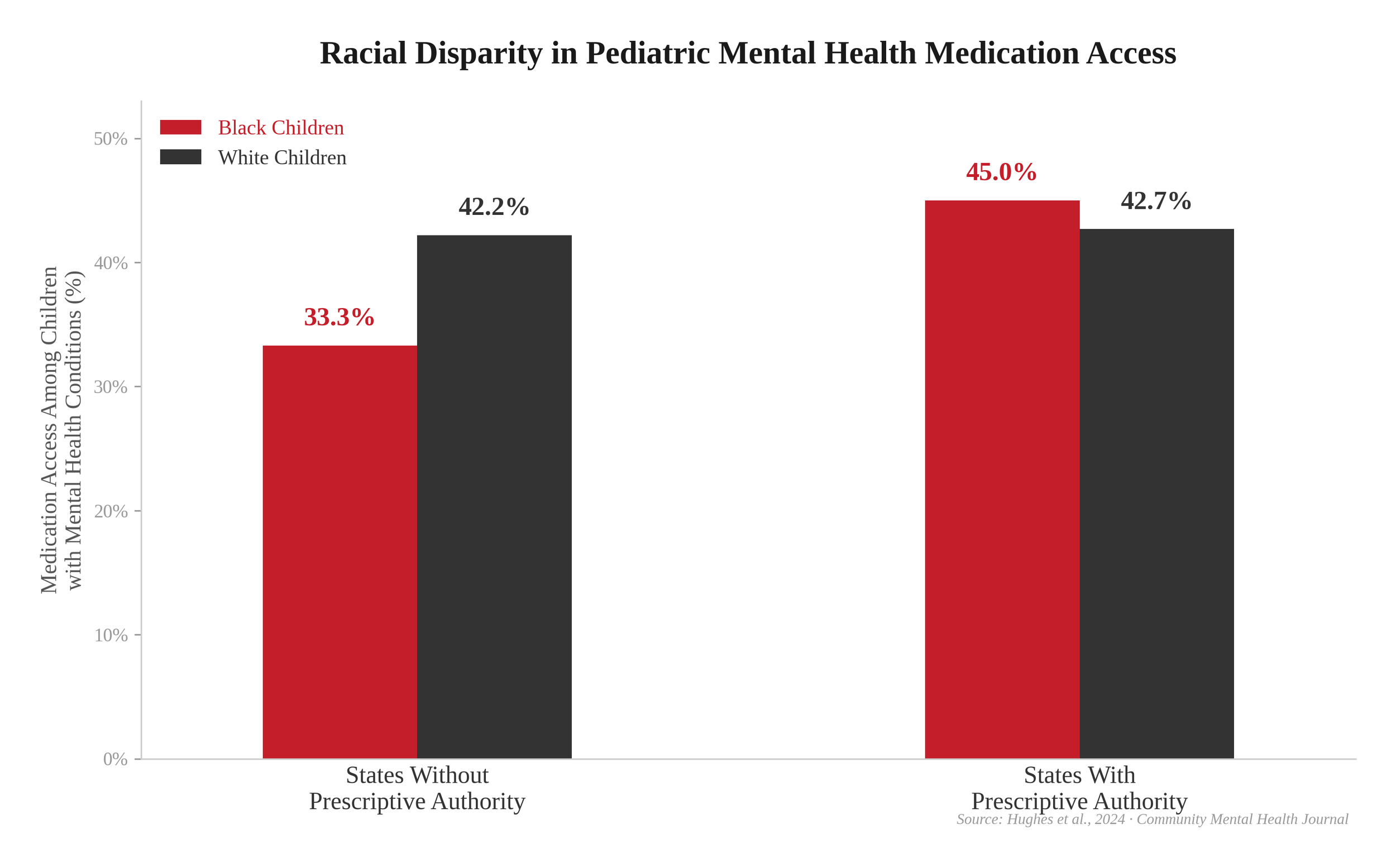
There were only about 250 prescribing psychologists nationwide at the time of the study. Despite that, RxP was associated with measurably better access and measurably smaller racial gaps — outcomes that nurse practitioner expansion, with a workforce of over 355,000, did not replicate for children.
24,698 Texans lost to suicide since 2017
Texas filed its first prescriptive authority bill in the early 2000s. It was reintroduced in 2017, 2019, 2021, 2023, and 2025. Each session, it did not pass. In the years since, an average of 4,116Texans have died by suicide every year — rising from 3,930 in 2018 to 4,392 in 2023.
Two independent studies — one by an economist, one by an epidemiologist — found that when states pass prescriptive authority, suicide rates decrease by 5 to 7 percent.
Here's what would change with RxP
In states that passed prescriptive authority, communities gained an average of eight new psychology practices for every million residents — often in counties that previously had no prescribing mental health provider at all.
The number of psychiatry practices in those same states did not decline. The data show that psychologists and psychiatrists function as complements, not substitutes — expanding access without displacing existing providers.
Nationally, adding prescribing psychologists to the existing workforce would increase the total number of mental health prescribers by roughly 30% — by leveraging a workforce that already exists, through training programs that are already running.
Prescriptive authority requires no new state appropriation, no new agency, and no new state-funded infrastructure. HB 5537 is a fee-funded licensure change administered by the existing Texas Behavioral Health Executive Council. In New Mexico, Medicaid reimburses prescribing psychologists at the same rate as psychiatrists.