RxP Training and Qualifications
Prescribing psychologists complete one of the longest and most specialized training pathways of any prescriber in the United States
a doctoral degree in psychology
a postdoctoral master's in clinical psychopharmacology
a national board examination
one year of a clinical fellowship, which consists of:
80 hours of physical assessment
400 hours of direct patient assessment & treatment
100 unique patients
two years of supervised prescribing
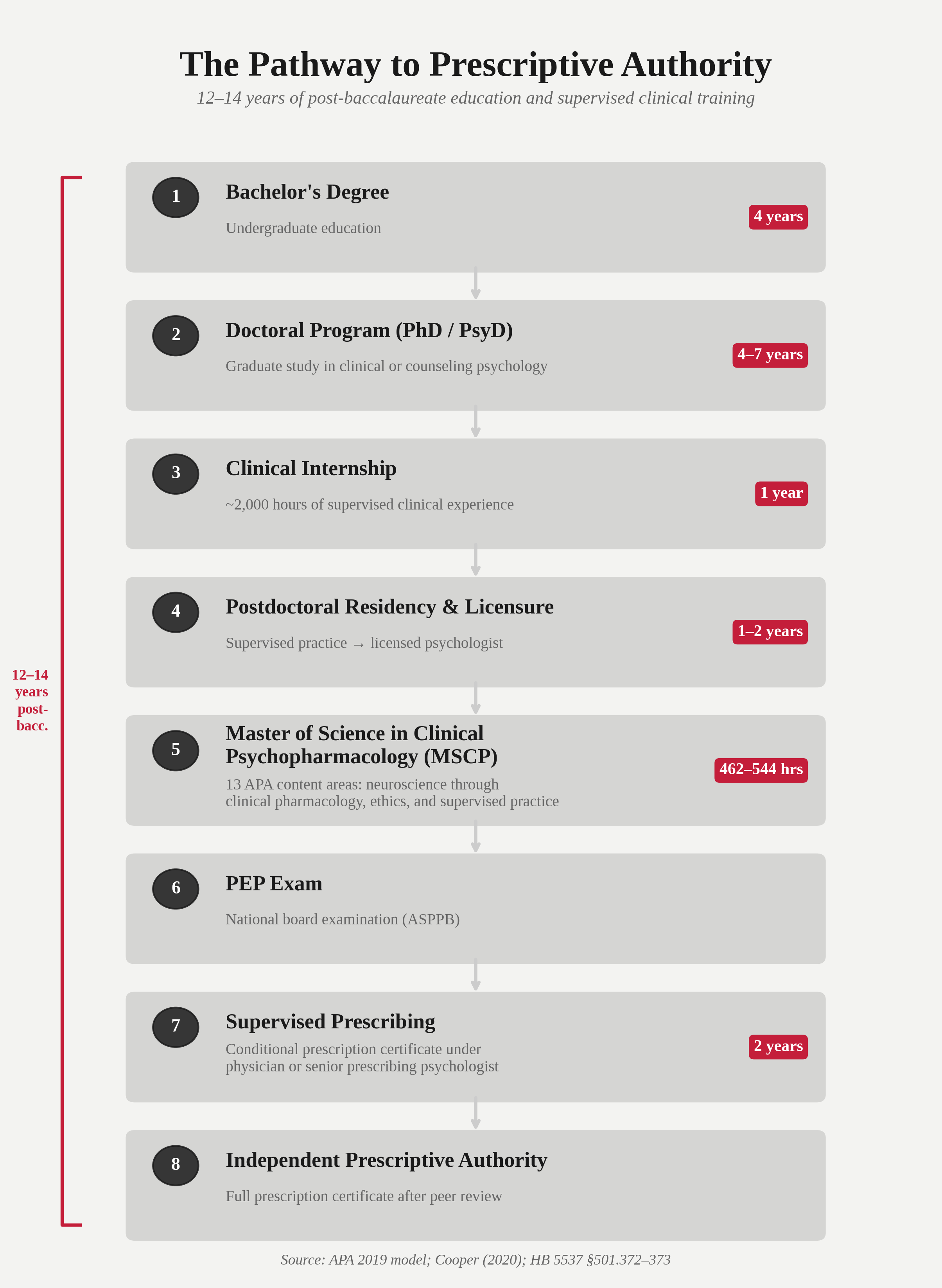
In total: twelve to fourteen years of post-baccalaureate education and clinical training before independent practice
12 to 14 years
The pathway begins with a doctoral program in clinical or counseling psychology — a PhD or PsyD — that typically requires four to seven years of graduate study, including a one-year clinical internship of approximately two thousand hours of training.
After completing a postdoctoral residency and earning licensure as a psychologist, candidates then pursue a postdoctoral Master of Science in Clinical Psychopharmacology, or MSCP.
Current MSCP programs require between 462 and 544 contact hours of postdoctoral pharmacological training, depending on the institution.
After completing the MSCP, candidates must pass the Psychopharmacology Examination for Psychologists, or PEP — a national board exam administered by the Association of State and Provincial Psychology Boards.
They then enter a minimum of two years of supervised prescribing before qualifying for independent prescriptive authority.
In total, a prescribing psychologist completes twelve to fourteen years of post-baccalaureate education and supervised clinical training before prescribing independently.
RxP Coursework
The American Psychological Association's recommended postdoctoral curriculum spans thirteen content areas. Basic sciences — anatomy, physiology, biochemistry, and genetics — may be completed at the undergraduate level. All remaining domains must be completed at the graduate level.
Graduate-level coursework includes:
Functional Neuroscience
Physical Examination
Pharmacokinetics
Vital Sign Interpretation
Pharmacodynamics
Laboratory Test Interpretation
Candidates study clinical medicine with dedicated attention to special populations — children, older adults, pregnant patients, and individuals with chronic conditions.
Pharmacology coursework covers:
Drug Interactions
Toxicology
Pathophysiology
Clinical Pharmacology
The most extensive component is psychopharmacology itself — every major class of psychotropic medication, from antidepressants and antipsychotics to stimulants and medications for substance use disorders, with dedicated modules in pediatric and geriatric prescribing, controlled substances, and cultural considerations.
The curriculum also requires coursework in psychopharmacology research methods and professional, ethical, and legal issues specific to prescriptive authority.
Beyond didactic instruction, the APA requires supervised clinical experience across all domains, including mentorship in polypharmacy management, medication tapering, integration of psychotherapy with pharmacotherapy, and consultation with other medical providers.
How the Training Compares
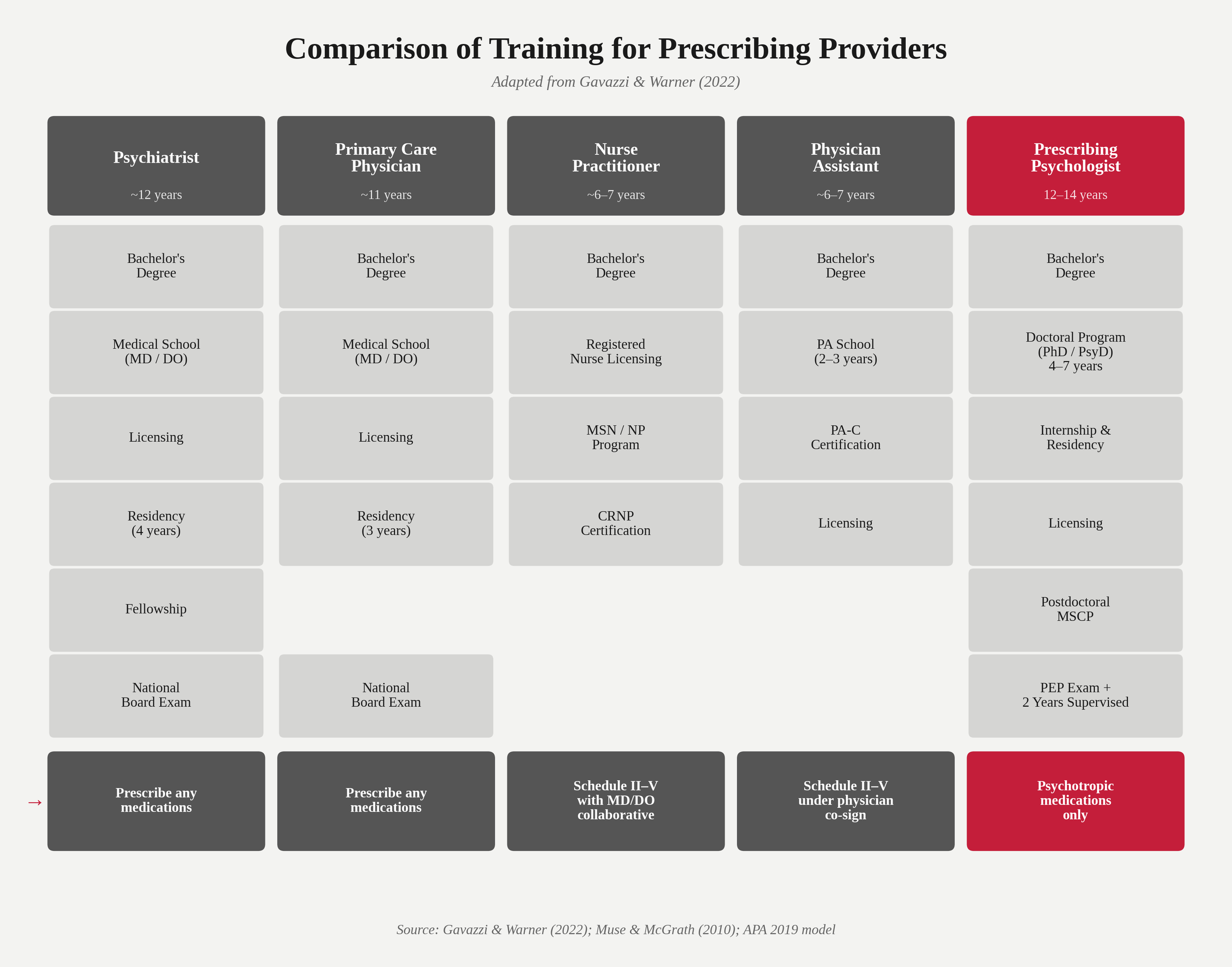
A peer-reviewed comparison of the three professions authorized to prescribe psychoactive medications — published in the Journal of Clinical Psychology — compared curricula across five medical schools, five psychiatric nurse practitioner programs, and all five postdoctoral MSCP programs then operating in the United States.
As detailed on The Crisis page, prescribing psychologists averaged 288 contact hours of dedicated pharmacology coursework, compared to 59 for physicians and 56 for psychiatric nurse practitioners. But the gap extends well beyond pharmacology.
In behavioral assessment and diagnosis, prescribing psychologists averaged 267 hours, compared to 18 for physicians and 30 for psychiatric nurse practitioners.
In psychosocial interventions and psychotherapy — the nonpharmacological treatments that prescribing psychologists integrate with medication management — the gap was 255 hours vs. 9 for physicians and 32 for psychiatric nurses.
In research and statistics, psychologists averaged 225 hours, compared to 33 for physicians and 99 for psychiatric nurses.
Physicians received more training in two areas: biochemistry-neuroscience (216 vs. 161 hours) and clinical practicum (855 vs. 680 hours).
In total, prescribing psychologists spend an average of 6.5 years in post-baccalaureate training, compared to 4 years for physicians and 2.5 years for psychiatric nurse practitioners.
Tested on The Same Exam
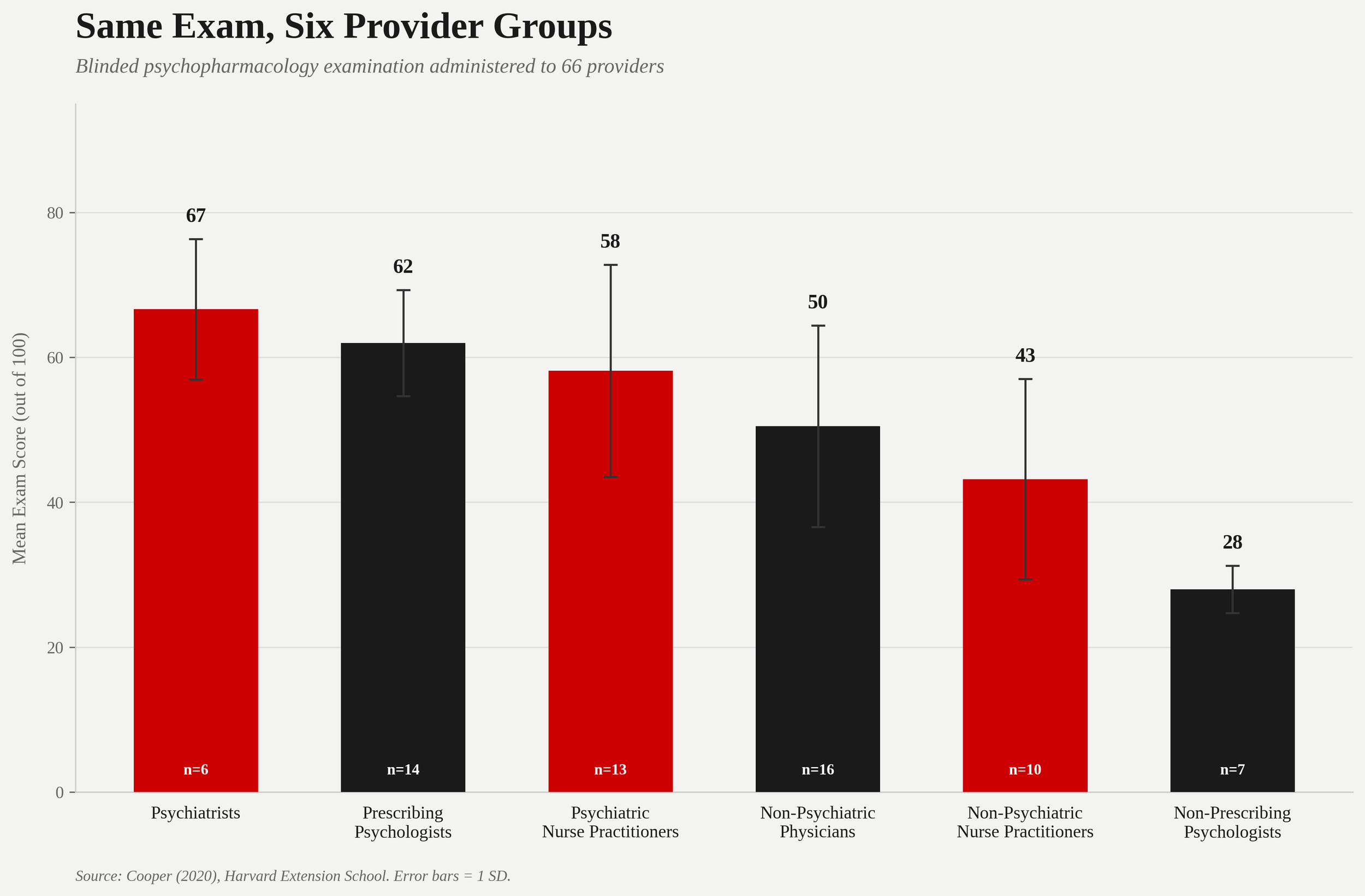
Comparing curricula demonstrates differences in training emphasis, but does not prove whether any given model produces competent prescribers.
A 2020 study addressed this directly by administering the same psychopharmacology examination to sixty-six providers across six groups: psychiatrists, prescribing psychologists, psychiatric nurse practitioners, general physicians, general nurse practitioners, and general psychologists.
Psychiatrists scored highest, followed by prescribing psychologists, then psychiatric nurse practitioners. There was no statistically significant difference in performance among these three specialist groups.
Non-psychiatric physicians and non-psychiatric nurse practitioners — the providers who write an estimated 80% to 90% of all psychotropic prescriptions in the United States — scored lower than all three specialist groups.
General psychologists without postdoctoral pharmacology training also scored significantly lower than prescribing psychologists, confirming that the competency difference is attributable to the MSCP training itself.
Physicians who have worked alongside prescribing psychologists in clinical settings have consistently rated their safety and clinical impact favorably.
A survey of forty-seven primary care physicians at a major U.S. Army medical facility found no concerns regarding patient safety and reported that overall patient care improved.
A subsequent study found that over 95% of physician colleagues agreed that prescribing psychologists were adequately trained and had adequate knowledge of relevant medical tests.
Where it Started
The training model now used in eight states and the U.S. military traces its origins to the Department of Defense Psychopharmacology Demonstration Project, launched in 1991. The DoD convened a Blue Ribbon Panel to design a curriculum that would train military psychologists to prescribe psychiatric medications independently.
The panel's initial curriculum consisted of 1,365 contact hours — a program that essentially mirrored medical school. After evaluation, the original program was found to be excessive for the goal of psychiatric prescribing.
The curriculum was reduced to 660 contact hours and refocused on the content areas most directly relevant to psychopharmacological practice. The revised program matriculated ten prescribing psychologists.
A 1999 Government Accountability Office review concluded that DoD program participants performed well in their prescribing roles.
Psychologists have been prescribing in the U.S. military for over thirty years, and that record of safe practice became the foundation for the civilian training programs that followed — beginning with New Mexico in 2002 and now encompassing eight states.
What HB 5537 Would Require
House Bill 5537, filed in the 89th Texas Legislature by Representative Mary González of El Paso, does not create a new state agency, does not require a new appropriation, and does not expand the scope of practice for any psychologist who has not completed the full training sequence. It is a fee-funded licensure change administered by the existing Texas Behavioral Health Executive Council.
Under Section 501.372 of HB 5537, a licensed psychologist seeking a conditional prescription certificate must complete a postdoctoral training program in psychopharmacology with instruction in seven defined areas — from basic life sciences through clinical pharmacotherapeutics and prescribing ethics — then pass a nationally recognized prescribing examination.
Before prescribing, the candidate must also complete an 80-hour physician-supervised practicum in clinical assessment and pathophysiology and a 400-hour clinical practicum treating mental disorders with psychotropic medication in no fewer than one hundred patients.
After receiving a conditional certificate, the psychologist prescribes under the supervision of a physician or fully certified prescribing psychologist for a minimum of two additional years, followed by an independent peer review before qualifying for a full prescription certificate.
The bill also requires prescribing psychologists to notify a patient's primary care provider within seventy-two hours of issuing or changing a psychotropic prescription and establishes an advisory committee — initially including a psychiatrist and a primary care physician — to set standards of practice and continuing education requirements.