House Bill 5537, filed by Representative Mary González, and its Senate companion SB 2999, filed by Senator José Menéndez, would let psychologists who complete advanced medical training prescribe psychotropic medication under a graduated, supervised license, leading to independent practice. It is the same model now operating in eight states and across the U.S. military. This page answers the questions a legislator asks before a vote: what the bill does, what it costs, whether it is safe, and what other states have found.
What These Bills Do and What They Cost
HB 5537 creates a two-tier certificate administered by the existing Texas Behavioral Health Executive Council. A psychologist first earns a conditional certificate, which requires a postdoctoral master's degree in clinical psychopharmacology, a national examination, and supervised clinical practica. Full prescriptive authority comes only after at least two additional years of prescribing under a supervising physician or prescribing psychologist and an independent peer review of that work. Authority is limited to psychotropic medication, and every prescriber must participate in the state's prescription drug monitoring program. Oversight runs through an advisory committee that, by statute, includes a psychiatrist and a pediatrician or primary care physician — the bill writes medical review into its own structure.
The measure carries no new appropriation and creates no new agency. It is a fee-funded licensure change: applicants pay for their own certification, and the work is absorbed by a council that already regulates Texas psychologists.
The Safety Record
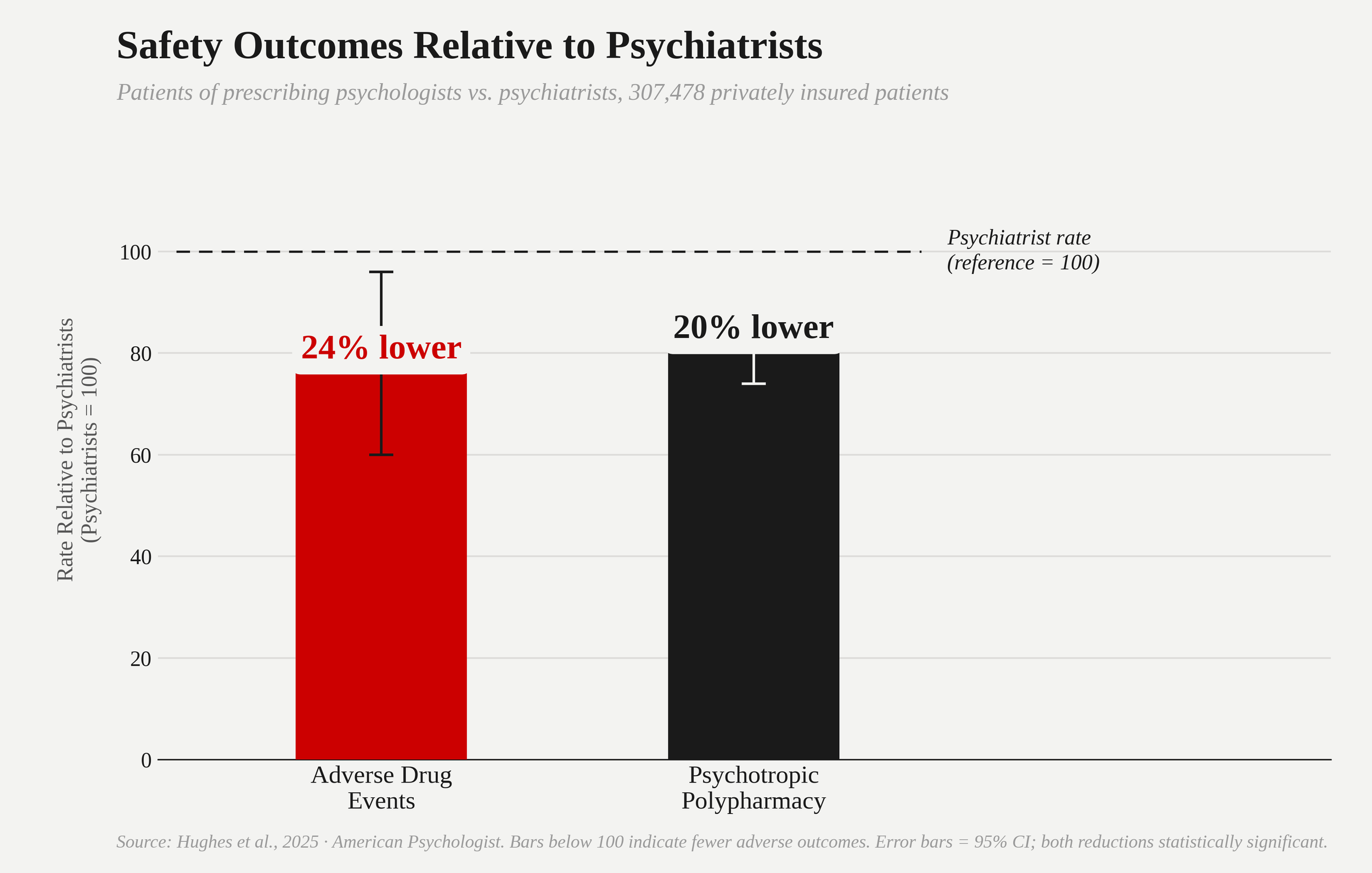
The question has an empirical answer. The largest study to date, published in American Psychologist in 2025, examined 307,478 privately insured patients and found that those treated by prescribing psychologists had a 24% lower rate of adverse drug events and a 20% lower rate of psychotropic polypharmacy than patients of psychiatrists, with comparable rates of emergency care and medication adherence.
A separate study found that prescribing psychologists adjusted downward or discontinued a medication for 57.8% of their patients — these are clinicians trained to take patients off unnecessary medication, not simply add to it. None of this is new: psychologists have prescribed safely in the Department of Defense and other federal systems for more than three decades, a history detailed on our Training page.
What Other States Found
Eight states have enacted prescriptive authority for psychologists — New Mexico (2002), Louisiana (2004), Illinois (2014), Iowa (2016), Idaho (2017), Colorado (2023), Utah (2024), and Vermont (2026) — and none has repealed it. The longest-running programs now have more than two decades of operating history. A peer-reviewed economic analysis of these laws found that prescriptive authority increased the supply of mental health practices without reducing the number of psychiatric practices, meaning prescribing psychologists expand access rather than displace physicians. And these clinicians serve the patients legislators most worry about reaching: in New Mexico, where the law has operated longest, 97% of prescribing psychologists accept Medicaid.
The Evidence Gap & Call to Action
Opposition to prescriptive authority has been examined on its own terms. A 2026 analysis published in Regulation, the policy journal of the Cato Institute, concluded that arguments against RxP are "strikingly devoid of empirical evidence," resting on hypotheticals rather than data from the eight states where the model already operates. We address those specific claims, point by point, on our Myths vs. Facts page.
Before the vote, we encourage you to read the bill in full, and contact us directly with any questions your office needs answered. We are glad to provide testimony, data, or a briefing on request.